
More than skin deep:
The biotech innovator transforming the cancer care experience
We are proud to share this feature by SATCC for our co-founder Dr. Marianna Prokopi-Demetriades
Dr. Marianna Prokopi-Demetriades is a biotech innovator and entrepreneur, specialising in transformative cancer care and personalised therapies. She is the co-founder of groundbreaking companies including Theramir, Promed Bioscience, and RSL Revolutionary Labs, and has been at the forefront of advancements in cancer treatment and regenerative medicine throughout her career.
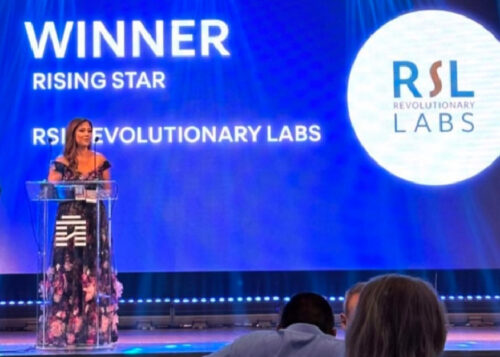
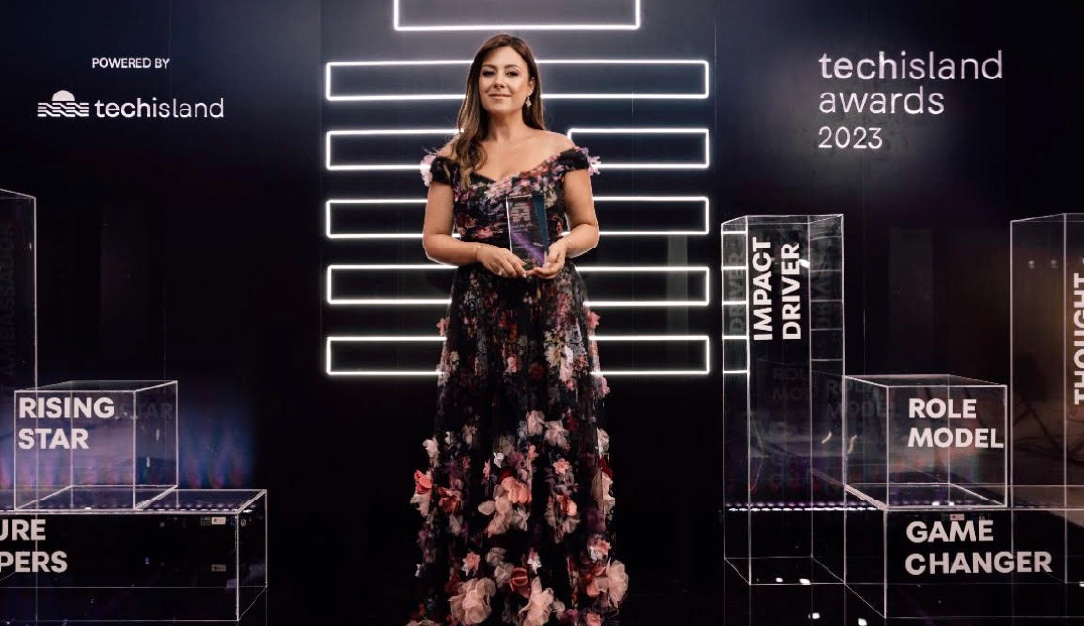
A King’s College London alumnus, she has also been the recipient of numerous accolades, including the 2024 Falling Walls Foundation Award, 2023 Forbes 20 WomenInTech Cyprus Award, the 2022 King’s Distinguished Alumni Award in STEM, and the 2023 TechIsland Award.
Like many with a passion to make a difference, her drive goes far beyond her professional skills, with first-hand experience watching loved ones battle cancer as well as the consequences of its treatment. Channelling her immense knowledge, vision, and empathy, she has navigated funding and logistical challenges to innovate in a way that is set to transform the cancer care experience from diagnosis to treatment, focusing on a better quality of life. She kindly gave us some of her time to explain.
The knowledge to drive change
I had wanted to get into science since I was very young. I was deeply in love with biology and wanted to be in research – working with a microscope in hand was the dream. I moved to the UK to study Molecular and Cellular Biology, followed by a Master’s degree in Biochemistry.
Initially, I thought I would go into diagnostics, which led me to complete a second Master’s degree in Microbiology and Virology, before falling in love with a new field at the time – stem cells. I was awarded a full PhD scholarship at King’s College London, where I conducted research at the newly established James Black Center, focusing on cardiovascular stem cell proteomics.
I completed my PhD in almost 18 months, which gave me an unexpected additional year and a half to explore further. That gave me the freedom and opportunity to enter the then ground breakthrough field of microRNAs, a pretty new topic at the time aimed at improving the early disease diagnosis. I later continued my academic journey with a short post-doctorate placement in nanotherapeutics at Hannover Medical School, which is at the forefront of revolutionising the treatment of disease whilst reducing the side effects of drugs – especially in cancer therapies. Coupled with the rest of my research and education to date, it was a really nice fit, channeling my knowledge into a particular translational direction.
On a personal note, it was around that period that I made a major life decision to move to Cyprus to be with my husband. Originally from Athens, I was comfortable moving around and naively believed that with hard work you could achieve anywhere in the world. However, this belief was tested more than I expected. I arrived here at the very beginning of the financial crisis, when research and academic positions were extremely limited. Ultimately, I entered into the pharmaceutical industry, working in quality assurance and validation. While it was an extremely valuable learning experience, it was not where I felt I truly belonged.
A personal journey
While I was feeling frustrated at work, my father was diagnosed with cancer and we lost him within just one month. My mother had died when I was nine, so it was just my younger sister and I. That further fuelled my desire to work in the field of cancer research and care. After he passed away, I secured a government research grant to work in my specialist field, within a spin-off from Imperial College, based at the Bank of Cyprus Oncology Center. Unfortunately, the financial crisis continued in Cyprus, and the company eventually closed.
For more than a decade, I had financed my own studies and while raising my children, I continued working across multiple roles. I took on part-time research projects for universities, taught a little, and later helped establish the Research Unit at the newly founded German Oncology Center. At times I was working four or five jobs simply to create a viable income. I was acutely aware of getting older, not earning enough, but most importantly not achieving what I wanted to.
Then my sister was diagnosed with ovarian cancer. That was a real wake-up call. I brought her from Greece to Cyprus to care for her, and my whole perspective shifted. Working in clinics is one thing, but it’s only really when you have someone in your family who suffers from the disease that you see the whole cancer journey from diagnosis to the hope that you might cure them, the first set of results, and the gradual move towards realising what’s happening. It was a two-year emotional roller coaster until Magda passed away in March 2018.

Making a difference
Around that time, I began working with a research collaborator who later became my business partner. Costas had spent 17 years in the United States before returning to Cyprus to raise his three boys. He has that wonderful optimistic mentality of being able to do anything. He is also like a big brother to me. I shared with him all these insights and frustrations that emerged from Magda’s cancer journey, especially the side effects of her treatment – I thought there had to be a better way.
So, together we decided that we could combine business and research, raising funds to develop better, more meaningful therapeutics for cancer care. The result, so far, is three companies – independent yet interconnected – and all focused on improving the way we treat and support people living with cancer.
Improving cancer diagnosis and treatment
Our journey began with Theramir, a company that combines our expertise in molecular and stem cell biology, nanotechnology, in vivo imaging and preclinical drug development. Theramir leads a focused research and development programme and in the emerging field of targeted microRNA therapeutics.
In essence, this represents a more personalised, targeted approach to cancer diagnosis and treatment. We pre-engineer extracellular vesicles, commonly known as exosomes in some fields, to target LCP-1 positive cancers. By downregulating the expression of this protein, we also suppress key metastatic pathways, with the potential to reverse cancer cells towards a normal phenotype. For the patients, this could mean fewer toxic side effects, reduced organ damage and far gentler therapeutic journeys compared to conventional treatments.
Although our patented EVmiR® platform has the theoretical potential to target more than 30 types of cancer, our current resources require a focused strategy. We are currently advancing a lead therapy for Triple-Negative Breast Cancer, while expanding into pancreatic and bladder cancers. To date we have demonstrated both safety and efficacy in animal models. We are now actively fundraising to complete Good Manufacturing Practice (GMP) development of the drug, submit our technical regulatory dossier, and progress into first-in-human clinical trials within the next two to three years.
Creating a better quality of life for cancer patients
In mid-2018, we created our second company, Promed Bioscience, focused on the development of advanced collagen-based biomaterials for organ bioprinting and regenerative medicine.
Many patients for example, undergo successful tumour removal but also require lymph node excision, which can result in conditions like lymphoedema. Today, we are working with international partners to develop collagen bioink that can be bioprinted into lymphatic nodes and surgically implanted to replace the missing lymph nodes after cancer surgery.
On a personal level, my sister didn’t really die from cancer itself, but from the severe side effects of treatment, including kidney failure and liver necrosis. As a metastatic cancer patient, she was not eligible for a liver transplant. This experience exposed a very harsh reality: cancer treatments, while life-saving, can cause devastating long-term damage to healthy organs, sometimes with fatal complications.
Alongside this, we collaborate with companies that develop collagen-based injectables for soft tissue regeneration. So, having worked for so many years coming up against brick walls and closed doors, we now hold major international contracts with organisations using our biomaterials to directly change and improve the quality of life for cancer patients.
Transforming skincare during and after cancer treatment
The final piece of the puzzle (at least for now), was my third idea. My sister experienced severe skin side-effects from her cancer treatment, including very uncomfortable radiation burns. The only recommendation available then was panthenol-based creams to try to soothe them. They were largely ineffective, and they were very sticky and uncomfortable, even making it a challenge to get dressed.
At the same time, once she was diagnosed, she wanted to get rid of all cosmetics that weren’t natural from her life. Yet, trying to find anything that met her needs – that was gentle but effective – was incredibly difficult in 2016. Magda was a chemist and a cancer researcher herself and loved making cosmetics in her little student kitchen, especially soaps. It was always our shared dream to create something out of that together.
After she passed away, I felt a strong need to create something in her memory that had real soul. As a creator in the medical space you rarely get to see the impact your ideas have on the people who need them, but skincare was something I could be involved in at every stage – the idea, the science, and the human feedback. The end result in this is very close to my heart because I can see my sister in it.
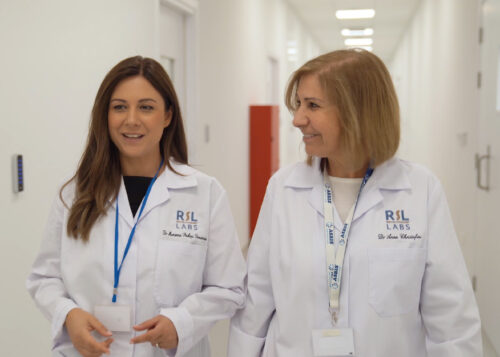
I was already developing the collagen biomaterials with Costas, and then I met a remarkable woman, Dr. Anna, an immunology and microbiology specialist in her seventies. She had been formulating natural cosmetics as a personal passion, and we decided to join forces. In 2019 we founded RSL, following a number of years developing the science and testing the products.
RSL brings together natural ingredients that don’t have side effects and are free from known carcinogens, all with a little biomaterial science. Our euSKIN® line of products is designed to care for the skin, before, during and after cancer treatment – preparation before someone starts cancer treatment, is as important as recovery afterwards. We chose a natural approach because many medical grade products rely on steroids or antibiotics, which can only be used short-term, without improving the regeneration of the skin. Cancer patients however, need products that will support them for a long period; for months or even years.
Although we had the highest-grade collagen for bioprinting organs, this collagen form could not be used in cosmetics because the molecular weight of the protein is too large to penetrate the skin and can only be dissolved in acid. We therefore applied for a local research grant to develop one of the first water-soluble, medical-grade atelocollagens suitable for dermal application. Within two years we successfully developed the material and reformulated our products.
We then conducted a registered clinical study with 100 breast cancer patients starting application of the innovative formulation one day before their radiation therapy. Compared with standard-of-care creams patients experienced a 94% reduction in Grade 1 and Grade 2 radiation dermatitis. The product is now under registration as a Class I medical device.
Today our products are exported to 12 regions around the world, and we have built a beautiful community of healthcare professionals, patients and carers who support, educate and raise awareness together.
Going forward
Cancer is such a complicated, extraordinary experience for patients and their families – it’s not just about whether we cure the disease or not – it’s also about quality of life.
The products we develop are not just about solitary use. They open new pathways for understanding and supporting patients in ways that are still unexplored. For example, I didn’t know that in some patients with metastatic lung or breast cancer, tumours can break through the skin, creating wounds that won’t heal – an experience which is both unpleasant and untreatable.
After seeing several patients with this condition, I initiated a new research project supported by a grant to develop a hydrogel containing atelocollagen, natural healing extracts and Theramir’s EVmiR anticancer platform. The idea is to locally reduce tumour activity while supporting the body’s healing process. This project is currently in in vivo testing, and within the next year we hope to complete development and explore its clinical application as either a medical device or a pharmaceutical product for complex open wounds.
From a business perspective, one of the greatest challenges and frustrations is knowing that at some point you have to either pause or even stop developing new ideas and focus on sustaining the existing ones. Funding is always limited and often founders put their teams before themselves. It’s not an easy journey, founders do everything – we raise the capital, create the ideas, lead the science, oversee development and manufacturing, the packaging, and the distribution, yet sustainability ultimately depends on reaching financial balance.
All of this work is driven by deep care and rigorous science. Yet, out there in the market we are up against global brands backed by enormous marketing budgets. Breaking through as an unknown brand takes a lot of time, persistence and trust – not only from patients and families, but also from healthcare professionals. At the same time, we continue to evolve, learn and refine our products.
Ultimately, this is my life’s work. We are only given a limited number of years in this world, and if I had to measure success in one way, it would be this: to be useful.



Leave A Comment